Showing posts with label music education. Show all posts

Wednesday, September 28, 2016

Mickey Mouse & Mozart

…one of my longer rants.    
Professional symphony orchestras in the United States face an annual challenge that we refer to in jest, belying the utter seriousness of the situation, as…‘getting butts in seats.’  This challenge is not new and it pervades the thinking of conductors, administrators and board members of orchestras ranging from the New York Philharmonic to regional orchestras.
One solution to declining audiences, developed decades ago, was the advent of the ‘Pops Concert.’  This originally entailed programming an entire concert of so called ‘light classical’ repertoire, and in some cases offering a series of these concerts.  Featured were compositions such as waltzes by Johann Strauss, Jr.  or Offenbach’s Barcarolle and perhaps included numbers from Broadway shows or other tunes from the American Songbook.  Eventually, medleys of music from Hollywood film scores also made their way into these ‘Pops Concerts’.
Historically, if we study the programs of regular subscription concerts of US professional symphony orchestras in the late 1800’s and early 1900’s, ‘light classics’ were routinely interspersed in concerts that also included works like a Beethoven Symphony.   Apparently, audiences, musicians and conductors in the early part of the 20th century had no difficulty whatsoever navigating between musical appetizers, sorbets, desserts and main courses.    Then – something happened.
In a recent article by Brian Wise in The New York Times entitled What’s Lost When Pops Orchestras Tap Pop Culture we find an interesting observation about exactlywhat happened.  “In 2004, Henry Fogel, then president of the League of American Orchestras, wrote an article for the League’s Symphony Magazine documenting the fading of once-popular works like Smetana’s tone poem The Moldau  and Chabrier’s flamenco-tinged España Comparing classical subscription programs of six major American orchestras from the early 1920s through 2001, he showed how light classics had nearly disappeared by 1960. ‘The development of pops as a separate thing actually hurt orchestras.’ Mr. Fogel said in a telephone interview.”
Orchestras began segregating repertoire, sorting what they deemed ‘serious music’ from ‘fluff’ which led to the development of  ‘Pops Concerts’ and ‘Pops Series’ and ultimately to the rise of separate professional musical entities in some cities: pops orchestras like the Cincinnati Pops, Philly Pops and New York Pops, featuring programs entirely dedicated to light repertoire.
One wonders whether composers of classical music ever made such mental distinctions themselves as they were writing. “Am I composing a light or serious composition?”  It is said that Beethoven was very fond of his Wellington’s Victory ­  – a composition hardly on the level of his symphonies or concertos, but one that he loved nonetheless.   Be that as it may, professional orchestras took the plunge into ‘Pops’ in search of larger audiences.
Presently, according to Wise, an even newer breed of ‘Pops Concerts’ has arrived.  These programs predominantly feature current popular performers and their songs, including hip-hop and rap artists.  Another big trend is that of having your local professional symphony orchestra replicate the entire sound track of a feature film – live – while that movie is being projected in your concert hall. Wise continues:  “The (NY) Philharmonic has drawn large audiences by showing films with live accompaniment; popular performances of…Disney’s ‘Fantasia: Live in Concert’ were added…” and also quotes Larry Tucker, the Nashville Symphony’s vice president for artistic administration: “Pops is a way to bring in money, but we also look at it as a way to bring in new audiences.”
Really?  Wise goes on to write that research from the League of American Orchestras shows that pops concerts are known to help financially subsidize classical series,but that the same research shows audiences seldom cross over from pops to classical concerts.  While it’s lots of fun to watch a movie as a live orchestra performs the score – harking back to ‘days of old’ when silent films were accompanied by a live organist in every movie theater – it’s expensive to pay a professional orchestra to replicate what has already been recorded by a professional orchestra in Hollywood.  And one wonders:  Do audience members who attend ‘movie score screening concerts’ also seldom ‘cross over’ to classical concerts?  I believe it is entirely likely that they do not.  
Cary Goldberg wrote in The New York Times on July 4, 1998:  “As music directors and administrators try various approaches to connect with new audiences – adding film screenings with live orchestral accompaniment, video game soundtracks, theatrical circus spectacles and 1990s rock acts – are they abandoning the large repertory that drew many listeners in the first place?”   Shouldn’t we perhaps also be asking: Did the players and conductors of our country’s finest symphony orchestras really give up their childhoods spending hours and hours everyday practicing the music of Mozart and enduring the rigors of music school in order to accompany feature films or rock artists replete with laser light shows?   Do we truthfully not think that movie theaters and rock musicians can actually do a better job of presenting themselves in their natural habitats than a symphony orchestra can in its concert hall?
But the most important question is this:  Is there really any special value to be derived – any earth-shattering, incomparable emotional-aesthetic experience to be had from giving 10-15 minutes one’s undivided attention to every note of a Brahms symphony movement?  If not…why should professional symphony orchestras continue to exist at all?  To be merely accompanists for a movie or a laser light show?
On the other hand, if there is some incredible personal reward to be gained from listening to classical music, then we have to find a much longer-term solution that needs to be initiated as soon as possible.  If, as a society, America started today to train all young children to be really perceptive listeners, enabling them to be moved to their very depths for instance by the abstract, wordless music of the Finale of Saint-SaënsThird Symphony …in 25 years, a rather large percentage of the US population might conceivably be banging down the doors of concert halls just to have the opportunity to sit in their seats and give their undivided aural attention as orchestras like The Philadelphia Orchestra or New York Philharmonic perform this incredibly stirring music live.
If we started this educational process tomorrow, it’s nevertheless likely that some professional orchestras may not still be here in 25 years.  And they certainly won’t be here if they’re banking on attempting to recreate what rock artists and movie theaters can do better – let alone if they become subsidiary food pantries, as some orchestras are currently doing in order to ‘connect with the community.’  And I’m not knocking social responsibility – simply noting that food banks such as AmpleHarverst.org and FeedingAmerica.org or your local community soup kitchen just might be able to do this better than a symphony orchestra which should, in any event, perhaps better spend its time teaching people of all ages how to listen to the material they were organized to perform in the first place.
Can it really be so simple?  That we just need to teach people how to listen? That we just need to teach people the listening skills that will enable them to deeply connect with classical music on an emotional level?  In 2017 The Discovery Orchestra will launch a PR campaign to stimulate a national conversation around the idea of Americans becoming better, more perceptive music listeners. It’s a concept that, who knows, might just find application to other aspects of life!

Wednesday, September 14, 2016

Can You Feel the Vibes?

When I was in high school it was common to hear someone say: “That person has good vibes.”  It was a compliment.  ‘That person’ was emitting positive energy that could almost be physically experienced.  Perhaps you have sensed this about certain individuals in your life.  Maybe you are one of those individuals.

Physicists have told us - in fact, Albert Einstein said:  “Everything in Life is Vibration.”  That’s everything!  If we could visually examine ‘solid’ objects around us - you know, objects like floorboards or rocks, as well as the more malleable ‘solid’ objects such as our skin – on an atomic level – we would be able to see that they are all vibrating!  We are vibrating, and this undoubtedly accounts for our intense attraction to music! 

Navajo mystic Joseph Rael said: “Inner listeners, or people who are continually listening to life as it unfolds, are true humans because they are picking up vibrational messages before the messages become crystallized energy or perceptual forms that can then be articulated by the brain.  Sensitivity, then, is paramount in developing the ability to be a good listener.” (Being & Vibration, Joseph Rael with Mary Elizabeth Marlow, Millichap Books, 1993.)

Could not have said it better myself.  Listening in the manner described by Joseph Rael is precisely the state we need to achieve when we encounter the music of Bach or Mozart or Beethoven or Chopin or Tchaikovsky or…

Joseph Rael also wrote: “Since people are made of sound, (emphasis mine) listening is important.  It is through listening that you become a true human, and a true human is a listener who is constantly attuned by working with everything that is happening.”

Perceptive listening, as opposed to merely hearing, is not just essential for experiencing all the emotionally rich detail that music contains.  Listening is essential for experiencing all that is life itself.


Monday, August 29, 2016

Conductor Humor

After my last, long rant on texting at symphonic concerts – I think it’s time to lighten up. Conductors notoriously take themselves too seriously. I guess it goes with the territory. But orchestral players have never been shy about putting conductors in their place. After all, as the saying goes: “The stick makes no sound” – which is not really true because the silent gestures we make on the podium do, in fact, influence the sound for better…or worse. But the point players are making is: “It is WE, the players, who actually produce the sounds, not that person waving the baton.”
How do professional orchestra musicians express their conductor humor? Well, first, there are the things they write in the parts they are playing from. If a conductor has a “tick” or a banal gesture repeatedly physically expressed, players have been known to make tally marks (IIII) in the parts during rehearsals. The same goes for keeping track of the number of times a conductor says the same unnecessary, inane remark.
When orchestral parts are rental material, one often finds a compendium of remarks that have accumulated in the parts over the course of performances by various orchestras around the world. I remember when I was playing in the viola section of one of the professional orchestras (name withheld to protect the guilty) I worked for over my playing career, a rented set of parts was on the stands that had just previously been used by the Chicago Symphony Orchestra. The music was a technically challenging contemporary work. One very difficult passage for the violas had the following message in the margin: “Fake it – Seiji Ozawa,” who had presided over the Chicago performances. My stand partner added in pencil: “Play EVERY NOTE!” – with the attribution to our music director who had just said that in rehearsal.
Then there are the jokes themselves. Some are vicious. When I moved to New York City in 1975, it wasn’t long before I heard the ‘New York Freelance Musician Conductor Joke’ – “What are three dead conductors floating face down in the Hudson River? A start.” Then there is the light bulb joke that I’ve also heard attributed to sopranos. “How many conductors does it take to change a light bulb? Three. One to change the light bulb. One to pull the ladder out from under the one changing the light bulb, and one to criticize this entire performance.” Some are slightly off color. I will partially sanitize here. “What is the difference between a symphony orchestra and a bull? A bull has the horns in the front and the ass in the back.”
My all-time favorite conductor joke? This one speaks more than any other to the love-hate relationship players have with conductors as expressed in their desire to look at the conductor as little as possible. “Just before curtain time at the opera, the house manager peers out from the wings to see that there is no conductor on the podium. Quickly getting on the phone he says: ‘Are there any assistant conductors in the house?’ ‘Nope’ comes the reply. Desperate, the house manager shouts into the pit: ‘Anyone down there who could conduct Tosca tonight?’ One violist (another reason I love this joke) starts waving his bow yelling: ‘I know it from memory. I can do it!’ ‘Get on the podium’ barks the house manager. And so the violist conducts a brilliant performance of Puccini’s Tosca – from memory, as promised. The next night, the violist sits down in his chair in the pit, and his stand partner turns to him and says: ‘Where were you last night?’”
If this is not enough for you, feel free to visit this website: Things People Said – Eugene Ormandy Quotes. Here you will find a totally bizarre collection of things Maestro Ormandy said over the years of his long tenure in Philadelphia, as lovingly documented by the members of that esteemed orchestra.

Does it take a lot of chutzpah to stand in front of an assemblage of Juilliard, Curtis, Oberlin, etc. graduates – all highly trained, accomplished artists who each expect you to know EVERY line of the score as well as each of them knows their own single line? You bet it does. It also helps not to take yourself so seriously!

Monday, August 15, 2016

Open Sesame

Do you remember the first time you encountered that phrase?  Perhaps you saw it in an English translation of Antoine Galland’s Les Mille et une nuits (One Thousand and One Nights…the story of Ali Baba and the Forty Thieves). In that case, you might have pronounced it: ‘Open See-same.’
Or perhaps you - like I - just heard some childhood friend say with a magical voice: ‘Open Ses-ah-mee!”  

As much fun as it might be to remember our first experiences with this phrase – still very much a part of English colloquial speech – it is a saying I find myself wanting to use whenever we present Fall in Love with Music, our basic listening course.

But open what?  Open one’s mind, of course.  And so it was a pleasure to read Michael Barrett’s article in Prelude, Fugue & Riffs (News for Friends of Leonard Bernstein Spring/Summer 2016) entitled: High-brow,Low-brow, All-brow Bernstein, Gershwin, Ellington, and the Richness of AmericanMusic

Erasing the imaginary boundaries between the genres of music – classical, jazz, pop, Broadway, world, etc. – was a personal mission of Maestro Bernstein, and Michael Barrett credits Maestro Bernstein with helping him to shed those boundaries – the artificial genre borders sometimes actually taught as “Gospel Truth’ to those of us who attended music schools and conservatories in the 20th century.

The importance of developing and maintaining an open mind is an integral concept of Fall in Love with Music.

In fact, Episode 3 ("Is This Music?”) of our new 8-part television series by the same name, takes up this very topic. 

Composers, whether they might be Mozart or John Lennon, have very open minds.  It is this quality of their personalities that allows them to notice things they like and admire in another composer’s music, and then permits them to restate those things in their own musical vocabularies.  This personality trait is what also gives them the ability to reshape their own ideas in a myriad of ways.

For listeners, it is essential to bring the same degree of open-mindedness to the listening process that composers bring to the composing process. When someone says: “I know what music I like…and I know what music I don’t like”…I worry.  I wonder: “With such a closed-minded attitude, have they really noticed all the wonderful details in the music they think they like?”

One of the composers lauded in Michael Barrett’s article is Duke Ellington.  If you’d like to spend 12 minutes with the great pianist – recorded live at a performance in France in 1966 – view this YouTube performance.

And by the way, Michael Barrett spends plenty of time helping people to understand and appreciate music as the conductor for Jamie Bernstein’s educational concerts.  I wrote a bit about this before in my 2013 blog The Bernstein Legacy. 

You just never know.  If we take the time to become perceptive listeners, noticing detail in music with an open mind…we may find ourselves getting goose bumps from an exceptionally cleverly written 30-second television or radio commercial jingle!

Thursday, August 4, 2016

Is Classical Music Dying? Part 2

In a March 2011 blog post I posed the question: "Is classical music dying?" My thoughts mostly concerned the precarious financial condition of many of America's professional symphony orchestras...a condition that, sadly, has improved only a little in the interim.  In the concluding paragraph I answered my own question. “I’d like to think that, were there just one human being left on the planet who was moved by this music, the flame would still flicker. Thankfully, there are yet many appreciators. But we must not kid ourselves — most of the US population remains largely uninvolved with this music because they simply don’t know how affected by it they could be!” This also, sadly, remains true. But, thankfully, all of us who passionately care about classical music may breathe one collective sigh of relief. That relief may be summed up in two words: ‘El Sistema.’
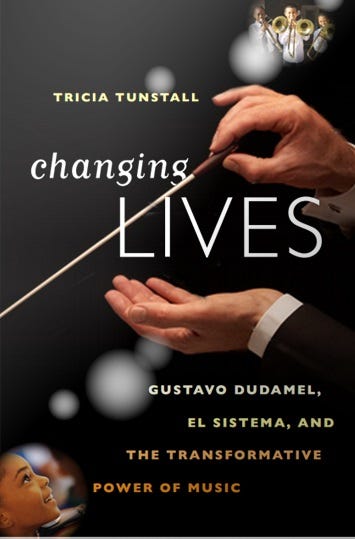
For more than a decade I’ve gotten to know musicians who were products of Venezuela’s incredible music educational program/social safety net known as El Sistema. Yet, to my own detriment, I failed to comprehend the full impact of this movement, that is, until I read Tricia Tunstall’s book: Changing Lives Gustavo Dudamel, El Sistema and The Transformative Power of Music (W.W. Norton & Company, 2012).


Changing Lives By Tricia Tunstall

You will be unable to put this book down.
Tricia Tunstall, a writer and music educator who lives in Maplewood, New Jersey, has been a friend and colleague for a number of years. To our delight, Tricia is an ardent fan of The Discovery Orchestra.
I simply had no idea what was really going on — not only in Venezuela, but also around the planet — as the “children” of Jose Antonio Abreu, founder of El Sistema, daily continue to transform the lives of literally hundreds of thousands of individuals. From reading Tricia’s riveting account of her time spent researching this miracle in Venezuela, I do not get the impression that Maestro Abreu was seeking to “save classical music” or keep it from dying. He was engaged in a much more urgent enterprise. He was saving the lives of the impoverished children living in the gang-infested barrios that surround cities such as Caracas, by teaching them to play orchestral instruments and organizing them into music educational dynamo ‘safety zones’ known as núcleos.
The results since this movement began are truly earth shattering and mindboggling. Take a look at this video. Not only have so many lives been transformed …not only have youth orchestras been started, cultivated and brought to such a high level of perfection that their playing rivals that of the greatest professional symphony orchestras … but, while engaged in the process of saving livesMaestro Abreu and his disciples have insured that ‘the light’ of classical music will not be extinguished! At least not for a very, very long time.
Thank you, Tricia, for chronicling the incredible saga of this now worldwide classical music educational engine for meaningful social change. What a welcome burst of good news in this time of depressing news cycles! I repeat: you will be unable to put this book down. To purchase a copy of this inspiring book, visit Tricia’s website.