Showing posts with label aha moment. Show all posts

Wednesday, September 28, 2016

Mickey Mouse & Mozart

…one of my longer rants.    
Professional symphony orchestras in the United States face an annual challenge that we refer to in jest, belying the utter seriousness of the situation, as…‘getting butts in seats.’  This challenge is not new and it pervades the thinking of conductors, administrators and board members of orchestras ranging from the New York Philharmonic to regional orchestras.
One solution to declining audiences, developed decades ago, was the advent of the ‘Pops Concert.’  This originally entailed programming an entire concert of so called ‘light classical’ repertoire, and in some cases offering a series of these concerts.  Featured were compositions such as waltzes by Johann Strauss, Jr.  or Offenbach’s Barcarolle and perhaps included numbers from Broadway shows or other tunes from the American Songbook.  Eventually, medleys of music from Hollywood film scores also made their way into these ‘Pops Concerts’.
Historically, if we study the programs of regular subscription concerts of US professional symphony orchestras in the late 1800’s and early 1900’s, ‘light classics’ were routinely interspersed in concerts that also included works like a Beethoven Symphony.   Apparently, audiences, musicians and conductors in the early part of the 20th century had no difficulty whatsoever navigating between musical appetizers, sorbets, desserts and main courses.    Then – something happened.
In a recent article by Brian Wise in The New York Times entitled What’s Lost When Pops Orchestras Tap Pop Culture we find an interesting observation about exactlywhat happened.  “In 2004, Henry Fogel, then president of the League of American Orchestras, wrote an article for the League’s Symphony Magazine documenting the fading of once-popular works like Smetana’s tone poem The Moldau  and Chabrier’s flamenco-tinged España Comparing classical subscription programs of six major American orchestras from the early 1920s through 2001, he showed how light classics had nearly disappeared by 1960. ‘The development of pops as a separate thing actually hurt orchestras.’ Mr. Fogel said in a telephone interview.”
Orchestras began segregating repertoire, sorting what they deemed ‘serious music’ from ‘fluff’ which led to the development of  ‘Pops Concerts’ and ‘Pops Series’ and ultimately to the rise of separate professional musical entities in some cities: pops orchestras like the Cincinnati Pops, Philly Pops and New York Pops, featuring programs entirely dedicated to light repertoire.
One wonders whether composers of classical music ever made such mental distinctions themselves as they were writing. “Am I composing a light or serious composition?”  It is said that Beethoven was very fond of his Wellington’s Victory ­  – a composition hardly on the level of his symphonies or concertos, but one that he loved nonetheless.   Be that as it may, professional orchestras took the plunge into ‘Pops’ in search of larger audiences.
Presently, according to Wise, an even newer breed of ‘Pops Concerts’ has arrived.  These programs predominantly feature current popular performers and their songs, including hip-hop and rap artists.  Another big trend is that of having your local professional symphony orchestra replicate the entire sound track of a feature film – live – while that movie is being projected in your concert hall. Wise continues:  “The (NY) Philharmonic has drawn large audiences by showing films with live accompaniment; popular performances of…Disney’s ‘Fantasia: Live in Concert’ were added…” and also quotes Larry Tucker, the Nashville Symphony’s vice president for artistic administration: “Pops is a way to bring in money, but we also look at it as a way to bring in new audiences.”
Really?  Wise goes on to write that research from the League of American Orchestras shows that pops concerts are known to help financially subsidize classical series,but that the same research shows audiences seldom cross over from pops to classical concerts.  While it’s lots of fun to watch a movie as a live orchestra performs the score – harking back to ‘days of old’ when silent films were accompanied by a live organist in every movie theater – it’s expensive to pay a professional orchestra to replicate what has already been recorded by a professional orchestra in Hollywood.  And one wonders:  Do audience members who attend ‘movie score screening concerts’ also seldom ‘cross over’ to classical concerts?  I believe it is entirely likely that they do not.  
Cary Goldberg wrote in The New York Times on July 4, 1998:  “As music directors and administrators try various approaches to connect with new audiences – adding film screenings with live orchestral accompaniment, video game soundtracks, theatrical circus spectacles and 1990s rock acts – are they abandoning the large repertory that drew many listeners in the first place?”   Shouldn’t we perhaps also be asking: Did the players and conductors of our country’s finest symphony orchestras really give up their childhoods spending hours and hours everyday practicing the music of Mozart and enduring the rigors of music school in order to accompany feature films or rock artists replete with laser light shows?   Do we truthfully not think that movie theaters and rock musicians can actually do a better job of presenting themselves in their natural habitats than a symphony orchestra can in its concert hall?
But the most important question is this:  Is there really any special value to be derived – any earth-shattering, incomparable emotional-aesthetic experience to be had from giving 10-15 minutes one’s undivided attention to every note of a Brahms symphony movement?  If not…why should professional symphony orchestras continue to exist at all?  To be merely accompanists for a movie or a laser light show?
On the other hand, if there is some incredible personal reward to be gained from listening to classical music, then we have to find a much longer-term solution that needs to be initiated as soon as possible.  If, as a society, America started today to train all young children to be really perceptive listeners, enabling them to be moved to their very depths for instance by the abstract, wordless music of the Finale of Saint-SaënsThird Symphony …in 25 years, a rather large percentage of the US population might conceivably be banging down the doors of concert halls just to have the opportunity to sit in their seats and give their undivided aural attention as orchestras like The Philadelphia Orchestra or New York Philharmonic perform this incredibly stirring music live.
If we started this educational process tomorrow, it’s nevertheless likely that some professional orchestras may not still be here in 25 years.  And they certainly won’t be here if they’re banking on attempting to recreate what rock artists and movie theaters can do better – let alone if they become subsidiary food pantries, as some orchestras are currently doing in order to ‘connect with the community.’  And I’m not knocking social responsibility – simply noting that food banks such as AmpleHarverst.org and FeedingAmerica.org or your local community soup kitchen just might be able to do this better than a symphony orchestra which should, in any event, perhaps better spend its time teaching people of all ages how to listen to the material they were organized to perform in the first place.
Can it really be so simple?  That we just need to teach people how to listen? That we just need to teach people the listening skills that will enable them to deeply connect with classical music on an emotional level?  In 2017 The Discovery Orchestra will launch a PR campaign to stimulate a national conversation around the idea of Americans becoming better, more perceptive music listeners. It’s a concept that, who knows, might just find application to other aspects of life!

Thursday, September 8, 2016

Art for Life’s Sake

On the evening of Monday, April 8, 2013 cellist Yo-Yo Ma delivered the Nancy Hanks Lecture on Arts and Public Policy at the Kennedy Center in Washington, D.C.  He called his presentation ‘Art for Life’s Sake.’  It is well worth the one-hour view on YouTube. Mr. Ma chose to end this address with a listening lesson for the audience.

I repeat. Mr. Ma chose to end this address with a listening lesson for the audience.

Why did he choose to do this?  He had, after all, most eloquently presented the case for the importance of art in our lives with wonderful musical demonstrations, impressive statistical results and inspiring words.  As he said in the summation of his main points:

“Societies are powered by three engines: politics, economics and culture. A vibrant society exists when all three engines are firing and intersecting, resulting in a populace that is energized, engaged and fulfilled. Our collective work in the arts is not just relevant, but essential to strengthening our culture and positively influencing society. Thus: ‘Art for Life's Sake.’  The arts are the way to foster the four critical skills necessary for our children to succeed in the 21st-century workforce: collaboration, flexibility, imagination, innovation.”

Yet, he chose to end the entire presentation by playing a Bach unaccompanied Sarabande – but before doing so Mr. Ma gave us a beautiful listening lesson which I encourage you to experience for yourself.  Why did he give us this listening lesson?

He did so because he understands that it is only by giving our undivided presence and attention to music that we, as listeners, truly become one with the music – noticing and being moved by the music’s detail as it unfolds.  It is only by listening, and not merely physically hearing, that we can receive the deepest benefits which music may impart.  And this is, of course, why the board, staff and members of The Discovery Orchestra are totally committed to fostering a national ‘listening conspiracy’ to encourage truly attentive listening among the members of our society.

On a personal note before beginning the lesson, Mr. Ma commented that he has played this Sarabande for his friends both on happy occasions such as weddings and on sad ones such as memorial services. One might say that he takes the enormous emotional-spiritual power of music with him wherever he goes…be it the concert hall or the hospital.  I can personally verify that this is true.  When my niece Rachel Simon, just out of college, was first treated in a Boston hospital for leukemia, Yo-Yo Ma appeared one day to play for one of his friends who, like Rachel, was very ill in the room across the hall.  Mr. Ma graciously included Rachel in this most intimate audience.  Many years later, after Rachel’s death, my wife Marcia and I saw Mr. Ma following a New Jersey performance. When Marcia identified herself as Rachel’s aunt he immediately embraced her, all three of us crying, unable to speak, so powerful was the memory of that occasion back in Boston.   ‘Art for life’s sake’ indeed!


The Discovery Orchestra applauds Mr. Ma for choosing to elevate the act of listening at a national forum in our country’s capitol.  As he said: “Our collective work in the arts is not just relevant, but essential to…positively influencing society.”  Listening is the key that unlocks the life-affirming power of music.  We cannot all be performers like Yo-Yo Ma.  Most of us will not be musical performers at all…but we all can become perceptive music listeners, the result of a conscious decision on our part that will change our lives forever.

Monday, August 29, 2016

Conductor Humor

After my last, long rant on texting at symphonic concerts – I think it’s time to lighten up. Conductors notoriously take themselves too seriously. I guess it goes with the territory. But orchestral players have never been shy about putting conductors in their place. After all, as the saying goes: “The stick makes no sound” – which is not really true because the silent gestures we make on the podium do, in fact, influence the sound for better…or worse. But the point players are making is: “It is WE, the players, who actually produce the sounds, not that person waving the baton.”
How do professional orchestra musicians express their conductor humor? Well, first, there are the things they write in the parts they are playing from. If a conductor has a “tick” or a banal gesture repeatedly physically expressed, players have been known to make tally marks (IIII) in the parts during rehearsals. The same goes for keeping track of the number of times a conductor says the same unnecessary, inane remark.
When orchestral parts are rental material, one often finds a compendium of remarks that have accumulated in the parts over the course of performances by various orchestras around the world. I remember when I was playing in the viola section of one of the professional orchestras (name withheld to protect the guilty) I worked for over my playing career, a rented set of parts was on the stands that had just previously been used by the Chicago Symphony Orchestra. The music was a technically challenging contemporary work. One very difficult passage for the violas had the following message in the margin: “Fake it – Seiji Ozawa,” who had presided over the Chicago performances. My stand partner added in pencil: “Play EVERY NOTE!” – with the attribution to our music director who had just said that in rehearsal.
Then there are the jokes themselves. Some are vicious. When I moved to New York City in 1975, it wasn’t long before I heard the ‘New York Freelance Musician Conductor Joke’ – “What are three dead conductors floating face down in the Hudson River? A start.” Then there is the light bulb joke that I’ve also heard attributed to sopranos. “How many conductors does it take to change a light bulb? Three. One to change the light bulb. One to pull the ladder out from under the one changing the light bulb, and one to criticize this entire performance.” Some are slightly off color. I will partially sanitize here. “What is the difference between a symphony orchestra and a bull? A bull has the horns in the front and the ass in the back.”
My all-time favorite conductor joke? This one speaks more than any other to the love-hate relationship players have with conductors as expressed in their desire to look at the conductor as little as possible. “Just before curtain time at the opera, the house manager peers out from the wings to see that there is no conductor on the podium. Quickly getting on the phone he says: ‘Are there any assistant conductors in the house?’ ‘Nope’ comes the reply. Desperate, the house manager shouts into the pit: ‘Anyone down there who could conduct Tosca tonight?’ One violist (another reason I love this joke) starts waving his bow yelling: ‘I know it from memory. I can do it!’ ‘Get on the podium’ barks the house manager. And so the violist conducts a brilliant performance of Puccini’s Tosca – from memory, as promised. The next night, the violist sits down in his chair in the pit, and his stand partner turns to him and says: ‘Where were you last night?’”
If this is not enough for you, feel free to visit this website: Things People Said – Eugene Ormandy Quotes. Here you will find a totally bizarre collection of things Maestro Ormandy said over the years of his long tenure in Philadelphia, as lovingly documented by the members of that esteemed orchestra.

Does it take a lot of chutzpah to stand in front of an assemblage of Juilliard, Curtis, Oberlin, etc. graduates – all highly trained, accomplished artists who each expect you to know EVERY line of the score as well as each of them knows their own single line? You bet it does. It also helps not to take yourself so seriously!

Tuesday, August 23, 2016

Secrets of Conducting

We know what you’re thinking!  Who is “we?”  We conductors know what many audience members are thinking when you attend our performances. From your perspective, it looks like a lion taming act!

The all-knowing, all-powerful maestro is cueing everyone in the orchestra. Small gestures, a tiny flick of a wrist, elicit gigantic changes in the volume level of the sound.

Yes, we know what you’re thinking…and some of us conductors may have even harbored similar notions about conducting when we were children or adolescents.  But!  When the moment came for us to actually play in a symphony orchestra (and many conductors began their professional lives as orchestral musicians), we learned one of the first secrets of conducting!  If you played in your high school orchestra or any other orchestra – you undoubtedly learned this yourself.  

The musicians actually make the sounds. And in order to do this effectively, they must first obey Itzhak Perlman’s dictum: “The most important thing to do is really listen.”  And by this, Maestro Perlman was not referring to the kind of listening as appreciators we teach at The Discovery Orchestra.

In order to perform well in an ensemble – whether there are two musicians or one hundred musicians – one must constantly listen to oneself and the other musicians simultaneously.  The brain becomes highly trained to instantly recognize tiny discrepancies in intonation.  “Am I playing ‘in tune’ with everyone else?”  And the body instantly responds by fixing any issues.

Equally important: “Am I in exact sync with everyone else?”  This is the phenomenon musicians refer to as ‘ensemble.’   Are we performing ‘as one’ rhythmically?  Again, we know what you’re thinking.  “Isn’t the conductor beating time?”   Yes, of course.  But all the time beating in the world won’t help one hundred musicians perform ‘as one’ if they are not really listening to each other – or if they are not motivated to do so.

Now we’re delving into the area of inspiration.  What makes a conductor inspiring to players?  Many attributes – most of which are transmitted during the rehearsals that precede the performance.  These attributes include, but are by no means limited to: a profound knowledge of the score,
reliable conducting technique, and perhaps most important, really passionate convictions and feelings about the music. 

I know that last one sounds ridiculously obvious.  But if a conductor does not have a really moving interpretation of the music that can be transmitted in a myriad of ways during the rehearsal period, professional players may not be motivated to really listen to each other.  And far worse, they may never feel like ‘putting out’ – giving the performance ‘their all.’

One final secret.  All the musicians in the orchestra have their own egos. This is as true for the last stand 2nd violinist as it is for the principal oboist.
I will never forget a session with my conducting teacher Richard Johannes Lert, an Austrian who was 96 when I studied with him.  His pedigree was impressive; Richard Strauss had been one of his teachers.

Here were ten young conductors in one of our first meetings with the old maestro.  Typical of young conductors, we were probably waiting for Dr. Lert to tell us the secret of controlling an orchestra.  Instead, he said softly in his Austrian accent: “When you come to the rehearsal, before you begin…look at the first oboist, look at one of the members of the viola section, look at the first horn.  And in your eyes communicate: ‘What wonderful thing do you have to say about this music as you play today’?”

Richard Lert, whom Johannes Brahms had bounced on his knee when Richard was a child, was saying to us that we should make every player in that orchestra feel that they are important and valued.  What a concept! Think on these things the next time you attend a performance.

Monday, August 22, 2016

Can We Really Multitask And Listen?

An article in symphony THE MAGAZINE OF THE LEAGUE OF AMERICAN ORCHESTRAS definitely caught my attention.  The Quest for Generational Diversity by Harvey Felder is an informative article that begins: “To connect with younger audiences, orchestras must understand and embrace the values of Generations X and Y.”  There is much of interest presented here by Maestro Felder and well worth reading.  There are lots of really good ideas for reaching these two generations.

“For multitasking Generations X (born 1965-76) and Y (1977-98), there must be multiple layers, all designed to broaden the experience beyond what has been thought of as sufficient for a symphony concert.  Consider the baseball fan who brings a portable radio or television to a game…The fan now has access to a stream of information he or she will miss by merely observing the game without electronic enhancement. In the concert hall, some Generation X and Y audience members undoubtedly would find the concert experience more attractive if they were offered a stream of information about the event they are witnessing.”

At The Discovery Orchestra, we have certainly found that audience members of Generations X and Y as well as those born well before 1965 have benefited from our listening guides that are first used as an exploration tool and then visually followed during the performance.   Our staff has discussed streaming the guides electronically at concerts – and we may well experiment with that in the near future. Our audience members tell us the listening guides help - and why?  Our listening guides encourage audience members to notice more detail and stay focused in the music!   As I said in my previous blog The Invisibility of Music “…a movement of music by Beethoven or Bach is delivered to us in time…the intent of the composer is always to have a continuous, non-stop presentation of their musical ideas.”  These musical ‘events’ – be they a chord change or an ascending sequence – are meant to be noticed and emotionally experienced as they occur in real time, one after the other.   If I stop to read the contributor’s list – let alone send or receive a text message – I risk missing some of these events as well as their relationship to musical ideas that occurred earlier.

Maestro Felder goes on to say: “Conversation, of course, must be curtailed during a concert, since it competes with the sonic creation emanating from the stage. But written (emphasis mine) communication and silent video screens can co-exist with live music.”  Here, he appears to be concerned with not disturbing audience members who are just listening.  He continues: “Problems may arise when the interactive style of Generations X and Y interferes with the listening style of other audience members.  One easy solution is to designate a section of the concert hall ‘silent mobile device friendly’ allowing the virtual community to engage in the multitasking and interactivity that is second nature to them.” 

I must respectfully disagree.  Rather than ‘styles’ of listening, I believe we are all consciously capable of applying variable degrees of attentiveness while listening.  At the bottom of the dial, we notice almost nothing except that there is perhaps a musical sound in the background which we are hearing while we do or think other things.  At the upper end is that state of attentiveness in which we are so present with the music that we notice every detail in the sounds we are hearing as they occur.  It is not so much having electronic mobile devices that worries me, especially if they were receiving a streamed listening guide.  What concerns me is the “multitasking and interactivity that is second nature to them” – as in texting.

Written communication and silent video screens may be able to ‘co-exist’ with live music.  However, people creating written communications with other device-users on and off the concert site – even if seated in a protective area where their lights and flashes will not disturb others – will likely miss, while texting, that one incredible re-harmonization of the melody which Rachmaninoff had calculated to be ‘the point’ or moment of greatest emotional intensity in the movement – not to mention a myriad of other musical details along the way. 

Is going to a baseball game an equivalent experience to going to a concert and listening to a Beethoven sonata?  I’m absolutely certain that Maestro Felder would not assert that.  But to emphasize my point…at the game, we watch the pitcher, and then we take a bite of our hotdog, then have a sip of soda, then call a friend on our cell phone. We do all these things because we can and it doesn’t matter in all of that ambient noise!  Even if we miss an entire half inning of play while we visit the restroom, it still doesn’t matter. But if we miss that one chord change as it happens in its unique moment in time, Rachmaninoff might say we would not understand the entire movement.  We might feel bad if missed seeing the grand slam while we were in the restroom – but we would still know the score, understand the game and enjoy the day at the ballpark!  At the concert, we have only that one precious moment to perceive that chord in its context.

I don’t believe that one would ever suggest we have a special ‘silent mobile device friendly’ section of a Broadway theater in which people could blissfully text each other while missing crucial dialogue lines of an Arthur Miller play.  How would these ‘texters’ understand the plot?  Is a symphonic movement not similar to an act of a play except that the information is all being conveyed in wordless abstract sound?
  
Understand we must, but rather than completely “embrace the values of Generations X and Y” perhaps orchestras should challenge those values.  There are individuals in the field of neuroscience who hold that we actually cannot multitask, that multitasking is a myth.  They maintain that even if we are consciously doing many things, our brain is still doing them serially – one at a time.  I’m not a scientist, but I think the dramatic increase in automobile accidents in America has already proven that people should not text and drive cars.  I would also ask: “Are there other life experiences where an instant electronic communication is not appropriate and would perhaps ruin the experience? Would we want to be texting at the precise moment that ice cream enters our mouths and surrounds our taste buds in a sea of pleasurable sensations?  Would we want to be texting a friend at the moment of orgasm?”  Might the act of listening to the music of Mozart or Thelonius Monk be a similar situation - something that just has to be singularly experienced?  


Do orchestras need to help Generations X and Y enjoy the concert experience?  Absolutely!  We know that the percentage of our entire population that regularly listens to classical music and attends live concerts is pitifully small.  Perhaps there is a remedy. How about we just teach Generations X and Y how to listen perceptively to the invisible language of music? We can then let them decide whether they really want to be texting at concerts or just giving their undivided attention to the most important communication in the room – a very intimate emotional exchange from the composer’s soul directly to theirs with an assist from us, the performers.

Thursday, August 4, 2016

Is Classical Music Dying? Part 2

In a March 2011 blog post I posed the question: "Is classical music dying?" My thoughts mostly concerned the precarious financial condition of many of America's professional symphony orchestras...a condition that, sadly, has improved only a little in the interim.  In the concluding paragraph I answered my own question. “I’d like to think that, were there just one human being left on the planet who was moved by this music, the flame would still flicker. Thankfully, there are yet many appreciators. But we must not kid ourselves — most of the US population remains largely uninvolved with this music because they simply don’t know how affected by it they could be!” This also, sadly, remains true. But, thankfully, all of us who passionately care about classical music may breathe one collective sigh of relief. That relief may be summed up in two words: ‘El Sistema.’
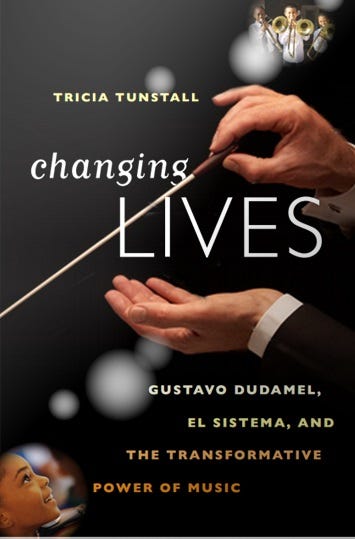
For more than a decade I’ve gotten to know musicians who were products of Venezuela’s incredible music educational program/social safety net known as El Sistema. Yet, to my own detriment, I failed to comprehend the full impact of this movement, that is, until I read Tricia Tunstall’s book: Changing Lives Gustavo Dudamel, El Sistema and The Transformative Power of Music (W.W. Norton & Company, 2012).


Changing Lives By Tricia Tunstall

You will be unable to put this book down.
Tricia Tunstall, a writer and music educator who lives in Maplewood, New Jersey, has been a friend and colleague for a number of years. To our delight, Tricia is an ardent fan of The Discovery Orchestra.
I simply had no idea what was really going on — not only in Venezuela, but also around the planet — as the “children” of Jose Antonio Abreu, founder of El Sistema, daily continue to transform the lives of literally hundreds of thousands of individuals. From reading Tricia’s riveting account of her time spent researching this miracle in Venezuela, I do not get the impression that Maestro Abreu was seeking to “save classical music” or keep it from dying. He was engaged in a much more urgent enterprise. He was saving the lives of the impoverished children living in the gang-infested barrios that surround cities such as Caracas, by teaching them to play orchestral instruments and organizing them into music educational dynamo ‘safety zones’ known as núcleos.
The results since this movement began are truly earth shattering and mindboggling. Take a look at this video. Not only have so many lives been transformed …not only have youth orchestras been started, cultivated and brought to such a high level of perfection that their playing rivals that of the greatest professional symphony orchestras … but, while engaged in the process of saving livesMaestro Abreu and his disciples have insured that ‘the light’ of classical music will not be extinguished! At least not for a very, very long time.
Thank you, Tricia, for chronicling the incredible saga of this now worldwide classical music educational engine for meaningful social change. What a welcome burst of good news in this time of depressing news cycles! I repeat: you will be unable to put this book down. To purchase a copy of this inspiring book, visit Tricia’s website.

Tuesday, July 26, 2016

How Shall We Study Music?

Last week I was given the privilege of speaking at a conference on the campus of Princeton University presented by the New Jersey Principals and Supervisors Association and the Foundation for Educational Administration.  The three-day event was underwritten by the Geraldine R. Dodge Foundation.

The conference theme, Using Arts-Infused Instruction to Enhance NJ’s Learning Standards, provided all of the artist-speakers with an opportunity to advocate for just how their art form can be used to advance the core curriculum standards of New Jersey’s Public Schools.

I am product of public education.  While it’s true that I received a very intense music education at St. Peter’s Choir School in Philadelphia, grades 4-7, the remainder of my secondary education was in a public school – Abraham Lincoln High School.  The musical studies and activities offered at Lincoln were typical for the 1960’s.

The emphasis was on teaching music performance.  There were two concert choirs, a chamber choir, two small chamber choral ensembles, two concert bands, a marching band, a jazz band, two orchestras…and an annual musical.  Sounds like a lot, doesn’t it?  But, for 5,000 total students, these ensembles involved a bit more than 500 students or 10% of the student body.

What was atypical at Lincoln, compared to any of Philadelphia’s other high schools at the time, was the presence of Saul Feinberg, my mentor. Using the two-year general music requirement, Saul taught aesthetic music listening skills (as opposed to music performance listening skills) to the remaining 90% of the student body.

How should we teach music?  Music instruction offered in schools should ideally mirror the three basic musical behaviors – creating (composing or improvising), performing and listening (from an aesthetic viewpoint.) 
In a perfect world, all students in school would receive instruction in composing/improvising, performing and listening.  Each year, from Kindergarten through Middle School, very specific standards could be set for each grade level. 

For example, by the end of 1st grade, every child will: be able to improvise in song or on an Orff xylophone a simple ostinato (creation); be able to sing a simple melody transmitted in Kodaly hand signals (performance); be able to recognize a simple ternary form (listening). 

Such a curriculum would produce a musically literate society, capable of performing, reading and inventing music – and most importantly – emotionally connecting with and appreciating, as listeners, the greatest music our society has produced regardless of genre – classical, jazz, pop, world or era – ­from medieval to the present.

But we don’t live in an ideal world.  And in the very real world of schools, many music curriculums are entirely performance oriented or nearly so.
Music education means: little children with violins in hand; kids singing in choirs and playing in bands; and performing in annual Broadway shows.
And all of that is very important, and not to be taken for granted where it exists – given the cuts to arts programs that we have experienced in recent decades.

But, short of offering comprehensive music education (encompassing all three musical behaviors), might we consider offering aesthetic music listening to all students, performers and non-performers alike?  This is what I proposed to my audience of Principals and Supervisors in Princeton.

We have some follow-up planned.  Stay tuned.

Tuesday, July 12, 2016

The Annual Recital


A few weeks ago I attended the annual recital of my wife Marcia’s piano students, who range in age from six to eighteen.  Annual student piano recitals have been a part of my life for as long as I can remember. My mother Helen taught in our home in Philadelphia, just as Marcia now does here in Bedminster.  The weekly parade of children sometimes seems to me like the only real constant in my life!

There is also my recollection of my personal feelings about participating in these recitals throughout my own career as a piano student. A mixture of exhilaration, dread, pride, abject terror and sheer joy in performing attended these recitals from the time of being one of my mother’s students all the way through music school, when my formal piano lessons ended.

The annual recital of a class of piano students is, however, much more than my own memories of them as a participant.  Attending one of them as an audience member gives one a very different perspective.

These events give every young instrumentalist a goal to aim toward.  And in listening to Marcia’s students, it was obvious that they all really took some sort of quantum leap that evening.  That, in itself, is a very worthwhile moment to have in one’s life.

How do I know this?  I have eavesdropped on their lessons – to a degree – all year long leading up to the big evening!  I know how “Jennie” had previously been performing Edvard Grieg’s Elfin Tanz.  At the recital she was positively transformed!   An opportunity to reinvent oneself…wow!

It was also nice to see how well these young people had been trained – by Marcia – to calmly walk to the keyboard and bow from the waist, acknowledging the initial applause.  Ah ha!  The annual recital also includes lessons in poise.

But perhaps one of the greatest gifts of preparing oneself for a recital appearance is having the chance to deal with the unexpected.  I have heard Marcia say to her students in a lesson:  “You know that you will not be able to stop playing in this spot in the recital.  So – if you make that same mistake - what will you do?”  And in this manner she prepares her students to “think on their feet” or “think on their hands” as it were.  “How can I improvise myself out of this problem and go on?”  That is an invaluable skill to learn and applicable to many situations in life.

So the next time you think you are just providing your daughter or son with piano lessons…think again!