Monday, August 15, 2016

Open Sesame

Do you remember the first time you encountered that phrase?  Perhaps you saw it in an English translation of Antoine Galland’s Les Mille et une nuits (One Thousand and One Nights…the story of Ali Baba and the Forty Thieves). In that case, you might have pronounced it: ‘Open See-same.’
Or perhaps you - like I - just heard some childhood friend say with a magical voice: ‘Open Ses-ah-mee!”  

As much fun as it might be to remember our first experiences with this phrase – still very much a part of English colloquial speech – it is a saying I find myself wanting to use whenever we present Fall in Love with Music, our basic listening course.

But open what?  Open one’s mind, of course.  And so it was a pleasure to read Michael Barrett’s article in Prelude, Fugue & Riffs (News for Friends of Leonard Bernstein Spring/Summer 2016) entitled: High-brow,Low-brow, All-brow Bernstein, Gershwin, Ellington, and the Richness of AmericanMusic. 

Erasing the imaginary boundaries between the genres of music – classical, jazz, pop, Broadway, world, etc. – was a personal mission of Maestro Bernstein, and Michael Barrett credits Maestro Bernstein with helping him to shed those boundaries – the artificial genre borders sometimes actually taught as “Gospel Truth’ to those of us who attended music schools and conservatories in the 20th century.

The importance of developing and maintaining an open mind is an integral concept of Fall in Love with Music.

In fact, Episode 3 ("Is This Music?”) of our new 8-part television series by the same name, takes up this very topic. 

Composers, whether they might be Mozart or John Lennon, have very open minds.  It is this quality of their personalities that allows them to notice things they like and admire in another composer’s music, and then permits them to restate those things in their own musical vocabularies.  This personality trait is what also gives them the ability to reshape their own ideas in a myriad of ways.

For listeners, it is essential to bring the same degree of open-mindedness to the listening process that composers bring to the composing process. When someone says: “I know what music I like…and I know what music I don’t like”…I worry.  I wonder: “With such a closed-minded attitude, have they really noticed all the wonderful details in the music they think they like?”

One of the composers lauded in Michael Barrett’s article is Duke Ellington.  If you’d like to spend 12 minutes with the great pianist – recorded live at a performance in France in 1966 – view this YouTube performance.

And by the way, Michael Barrett spends plenty of time helping people to understand and appreciate music as the conductor for Jamie Bernstein’s educational concerts.  I wrote a bit about this before in my 2013 blog The Bernstein Legacy. 

You just never know.  If we take the time to become perceptive listeners, noticing detail in music with an open mind…we may find ourselves getting goose bumps from an exceptionally cleverly written 30-second television or radio commercial jingle!

Thursday, August 4, 2016

Is Classical Music Dying? Part 2

In a March 2011 blog post I posed the question: "Is classical music dying?" My thoughts mostly concerned the precarious financial condition of many of America's professional symphony orchestras...a condition that, sadly, has improved only a little in the interim.  In the concluding paragraph I answered my own question. “I’d like to think that, were there just one human being left on the planet who was moved by this music, the flame would still flicker. Thankfully, there are yet many appreciators. But we must not kid ourselves — most of the US population remains largely uninvolved with this music because they simply don’t know how affected by it they could be!” This also, sadly, remains true. But, thankfully, all of us who passionately care about classical music may breathe one collective sigh of relief. That relief may be summed up in two words: ‘El Sistema.’
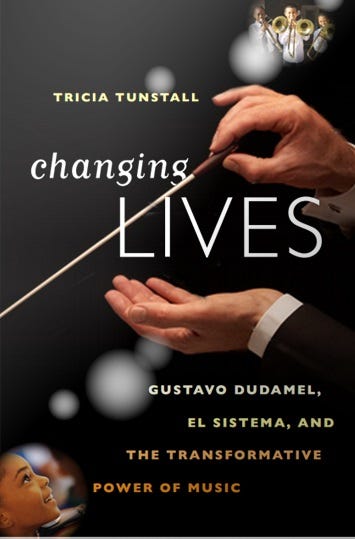
For more than a decade I’ve gotten to know musicians who were products of Venezuela’s incredible music educational program/social safety net known as El Sistema. Yet, to my own detriment, I failed to comprehend the full impact of this movement, that is, until I read Tricia Tunstall’s book: Changing Lives Gustavo Dudamel, El Sistema and The Transformative Power of Music (W.W. Norton & Company, 2012).


Changing Lives By Tricia Tunstall

You will be unable to put this book down.
Tricia Tunstall, a writer and music educator who lives in Maplewood, New Jersey, has been a friend and colleague for a number of years. To our delight, Tricia is an ardent fan of The Discovery Orchestra.
I simply had no idea what was really going on — not only in Venezuela, but also around the planet — as the “children” of Jose Antonio Abreu, founder of El Sistema, daily continue to transform the lives of literally hundreds of thousands of individuals. From reading Tricia’s riveting account of her time spent researching this miracle in Venezuela, I do not get the impression that Maestro Abreu was seeking to “save classical music” or keep it from dying. He was engaged in a much more urgent enterprise. He was saving the lives of the impoverished children living in the gang-infested barrios that surround cities such as Caracas, by teaching them to play orchestral instruments and organizing them into music educational dynamo ‘safety zones’ known as núcleos.
The results since this movement began are truly earth shattering and mindboggling. Take a look at this video. Not only have so many lives been transformed …not only have youth orchestras been started, cultivated and brought to such a high level of perfection that their playing rivals that of the greatest professional symphony orchestras … but, while engaged in the process of saving lives, Maestro Abreu and his disciples have insured that ‘the light’ of classical music will not be extinguished! At least not for a very, very long time.
Thank you, Tricia, for chronicling the incredible saga of this now worldwide classical music educational engine for meaningful social change. What a welcome burst of good news in this time of depressing news cycles! I repeat: you will be unable to put this book down. To purchase a copy of this inspiring book, visit Tricia’s website.

Tuesday, July 26, 2016

How Shall We Study Music?

Last week I was given the privilege of speaking at a conference on the campus of Princeton University presented by the New Jersey Principals and Supervisors Association and the Foundation for Educational Administration.  The three-day event was underwritten by the Geraldine R. Dodge Foundation.

The conference theme, Using Arts-Infused Instruction to Enhance NJ’s Learning Standards, provided all of the artist-speakers with an opportunity to advocate for just how their art form can be used to advance the core curriculum standards of New Jersey’s Public Schools.

I am product of public education.  While it’s true that I received a very intense music education at St. Peter’s Choir School in Philadelphia, grades 4-7, the remainder of my secondary education was in a public school – Abraham Lincoln High School.  The musical studies and activities offered at Lincoln were typical for the 1960’s.

The emphasis was on teaching music performance.  There were two concert choirs, a chamber choir, two small chamber choral ensembles, two concert bands, a marching band, a jazz band, two orchestras…and an annual musical.  Sounds like a lot, doesn’t it?  But, for 5,000 total students, these ensembles involved a bit more than 500 students or 10% of the student body.

What was atypical at Lincoln, compared to any of Philadelphia’s other high schools at the time, was the presence of Saul Feinberg, my mentor. Using the two-year general music requirement, Saul taught aesthetic music listening skills (as opposed to music performance listening skills) to the remaining 90% of the student body.

How should we teach music?  Music instruction offered in schools should ideally mirror the three basic musical behaviors – creating (composing or improvising), performing and listening (from an aesthetic viewpoint.) 
In a perfect world, all students in school would receive instruction in composing/improvising, performing and listening.  Each year, from Kindergarten through Middle School, very specific standards could be set for each grade level. 

For example, by the end of 1st grade, every child will: be able to improvise in song or on an Orff xylophone a simple ostinato (creation); be able to sing a simple melody transmitted in Kodaly hand signals (performance); be able to recognize a simple ternary form (listening). 

Such a curriculum would produce a musically literate society, capable of performing, reading and inventing music – and most importantly – emotionally connecting with and appreciating, as listeners, the greatest music our society has produced regardless of genre – classical, jazz, pop, world or era – ­from medieval to the present.

But we don’t live in an ideal world.  And in the very real world of schools, many music curriculums are entirely performance oriented or nearly so.
Music education means: little children with violins in hand; kids singing in choirs and playing in bands; and performing in annual Broadway shows.
And all of that is very important, and not to be taken for granted where it exists – given the cuts to arts programs that we have experienced in recent decades.

But, short of offering comprehensive music education (encompassing all three musical behaviors), might we consider offering aesthetic music listening to all students, performers and non-performers alike?  This is what I proposed to my audience of Principals and Supervisors in Princeton.

We have some follow-up planned.  Stay tuned.

Tuesday, July 12, 2016

The Annual Recital


A few weeks ago I attended the annual recital of my wife Marcia’s piano students, who range in age from six to eighteen.  Annual student piano recitals have been a part of my life for as long as I can remember. My mother Helen taught in our home in Philadelphia, just as Marcia now does here in Bedminster.  The weekly parade of children sometimes seems to me like the only real constant in my life!

There is also my recollection of my personal feelings about participating in these recitals throughout my own career as a piano student. A mixture of exhilaration, dread, pride, abject terror and sheer joy in performing attended these recitals from the time of being one of my mother’s students all the way through music school, when my formal piano lessons ended.

The annual recital of a class of piano students is, however, much more than my own memories of them as a participant.  Attending one of them as an audience member gives one a very different perspective.

These events give every young instrumentalist a goal to aim toward.  And in listening to Marcia’s students, it was obvious that they all really took some sort of quantum leap that evening.  That, in itself, is a very worthwhile moment to have in one’s life.

How do I know this?  I have eavesdropped on their lessons – to a degree – all year long leading up to the big evening!  I know how “Jennie” had previously been performing Edvard Grieg’s Elfin Tanz.  At the recital she was positively transformed!   An opportunity to reinvent oneself…wow!

It was also nice to see how well these young people had been trained – by Marcia – to calmly walk to the keyboard and bow from the waist, acknowledging the initial applause.  Ah ha!  The annual recital also includes lessons in poise.

But perhaps one of the greatest gifts of preparing oneself for a recital appearance is having the chance to deal with the unexpected.  I have heard Marcia say to her students in a lesson:  “You know that you will not be able to stop playing in this spot in the recital.  So – if you make that same mistake - what will you do?”  And in this manner she prepares her students to “think on their feet” or “think on their hands” as it were.  “How can I improvise myself out of this problem and go on?”  That is an invaluable skill to learn and applicable to many situations in life.

So the next time you think you are just providing your daughter or son with piano lessons…think again!  


Tuesday, August 14, 2012

Mea Culpa!

To my followers: 

I've been writing, but you would never have known it.  The Discovery Orchestra has engaged some wonderful consultants during the last twelve months, and there's nothing quite like having really good help!  Among their suggestions was one to consolidate all of our internet presence, including Notes from Maullaria, on our new website.

This blog has migrated to our website and you may find my thoughts - if they are still of interest after this long hiatus - at www.discoveryorchestra.org. I apologize for somehow missing that it was my responsibility to alert you to this.

George

Monday, November 28, 2011

Take Me Out to the Ball Game


My apologies for the 'sounds of silence' since my June 30th entry.  My brain’s been seeking but not finding more answers to the decline in classical concert attendance.  In this state of writer’s block I visited Yankee Stadium on September 3.  Sitting with the other 50,000 fans, I was overwhelmed by the thought - obviously, people are still attending certain kinds of live events in large numbers, regardless of the economy!

I know.  It’s not the same.  Attending sports events entails a completely different set of behaviors.  We may not only talk with friends, but we are encouraged to boisterously cheer for the team.  We’re prodded to eat the expensive food during the game.  We may even become, if not overly so, intoxicated with alcoholic beverages!  Vendors yell and scream.  We’re permitted to wander the stadium at will. 

Loud, participatory behavior is also a normal element of rock concerts.  When held outdoors, the same freedom of movement is tolerated as attendees smoke tobacco and other substances.  Contrast that with an event where one is required to sit quietly without moving.  No wonder people don’t want to attend classical music concerts! 

Months of silence have convinced me I’m asking the wrong question.  The compelling issue is: Why does the clear majority of the population not want to quietly sit and listen to classical music – regardless of the setting – neither in the concert hall nor at home?

This leads me to recent comments made by Walter Isaacson, Steve Job’s biographer.  In an interview, Mr. Isaacson spoke of the profound change Edison wrought on all music by inventing the wax cylinder - a favorite theme of mine I call ‘The Edison Effect.’  Our relationship with music has never been the same since Edison's 1878 patent.  It was the beginning of music 'consumption', as some like to call it, as a private behavior…something one could do by oneself without the presence of either live performers or even other live 'audience' members.

Walter Isaacson went on to say that Steve Jobs’s development of the iPod, created a change in our relationship with music every bit as profound as Edison’s cylinder.  The ‘private-ness’ of our music experience was exponentially heightened by the arrival of the iPod.  People can tell me till the cows come home “There is nothing like a live classical concert!”  I think they’re right, but we need to come to grips with the reality that private music listening is now the primary mode of music listening for people in the industrialized world.  Does that, will that gigantic shift in human behavior significantly alter the consumption of classical music as well?

Steve Jobs literally “did his job.”  Daily, millions connect with their custom downloaded music libraries through earbuds.  Sidestepping the viability of live classical performance and the ultimate fate of professional symphony orchestras, let’s assume that more and more people - individuals who have total control over the content of their iPods - will make private music listening the rule.

What percentage will be listening to classical music?  10%?  5%?  3%?  And if someone is part of the 90% or more who are not listening regularly to classical music, I reassert something I’ve said before – it's likely they simply do not know from personal experience just how moved they might be by classical music listening.  So how do we get them to know that? – to experience that?

We frequently ask ourselves at the TDO office: What can The Discovery Orchestra do to encourage an uninitiated person to watch our YouTube Discovery Chats or Discovery Concert DVD’s?  How do we cajole people to visit our YouTube Channel?  How do we  get someone to ‘give us five’?  And if they do, will this visit do the job?  We hope a five-minute encounter might ignite a pleasure response mechanism that can only be achieved by listening with undivided attention. 

We want your suggestions!  All of them!


Thursday, June 30, 2011

It's The Money Stupid! Or Is It?


Concert hall acoustics and the effects of continuously dissonant musical compositions definitely have their impact on concert attendance or the lack thereof.        

Another frequently discussed factor is the price of admission.  As we should know, whatever price is being charged for a classical concert ticket, it does not cover the cost of producing the concert.  We have been using the same financial model in the United States for over a century, imported from Europe, in which somewhere between 50% and 80% of concert cost is being subsidized by philanthropic contributions.  So if we meet in the middle at 65% being the contributed portion of concert cost, it means that a $50 average ticket price - prior to any senior, student or group discounts - should have realistically been $145 in order for the concert to break even.   And we need to quickly note that the break-even ticket price may vary up or down relative to the total annual budget, hall capacity and average attendance.

While an avid sports fan or rock concert attendee might happily pay $200 or more for an event ticket, I don’t think we even need ask how many regular classical music concert attendees would be willing to pay about $150 to listen to a live performance of a Beethoven symphony.   We have all been trained to expect the subsidized ticket price.  And even that may now be beyond the reach of some patrons on fixed retirement incomes or younger individuals stretched by current recessionary economic conditions.

This begs the question – should ticket prices be lowered?  A few professional orchestras are in fact doing this and obtaining improved attendance results.  In other instances a single, low very affordable ticket price for every seat has been instituted.  There are those who have recommended that tickets to all classical concerts simply be made available free of charge!  When one arrives at the door there might be a suggested but not required contribution, as is the practice at some art museums.  I have even encountered a 'pay as you exit' strategy.  If you like the concert, pay for your ticket as you leave.  If not – don’t!     

These are intriguing ideas, all to some degree based on the proposition that if so little income is to be recouped from classical music concert tickets in the first place, why not simply make classical music concerts a completely philanthropic gift from donors to the community?   My guess is that this strategy would have to be balanced against such ingrained beliefs as: “If something is free, it can’t really be worth anything.” and “You don’t get something for nothing.”

In this context, a quote from Penelope McPhee, who formerly oversaw the John S. & James L. Knight Foundation’s Magic of Music (http://bit.ly/jsdru5) initiative, lingers in my mind as a haunting prediction.  It still gives me chills to recall it, and it makes me question whether ticket prices have anything whatsoever to do with the decline in classical music concert attendance.

Addressing a group of marketing executives from professional symphony orchestras with budgets ranging from perhaps one million dollars to as much as forty million dollars annually, Ms. McPhee said something like - and I am paraphrasing here: “If nothing changes, in a few years you won’t even be able to give away your product, let alone sell tickets to it.”  A sobering thought to say the least, and one which causes this observer to look to yet other reasons why classical concert audiences are declining.